One year on...
Saturday, 15 December 2012

Sunday, 9 December 2012
Stocking filler

Just to let you know. There is 25% off the print version of Unbelievable until Christmas, if you buy it from Lulu.com.
It would be an ideal stocking filler for a friend or family.
Monday, 3 December 2012
Poking the bear
A couple of weeks ago, just
for giggles, I decided to tweet Shirley Phelps-Roper from the
Westboro Baptist Church, telling her about my book, linking to my
blog and asking for a retweet

Strangely enough, I've not yet received a response.

Today, I tweeted a similar request to the Pope. I sent two tweets, one in German and one in English. *
I wonder if, unlike that Phelps-Roper woman, the Bishop of Rome; the Vicar of Christ on Earth; the Holder of the Keys of Saint Peter, will do the right thing. We'll see...
*EDIT
After some advice from a friend, I have sent another tweet in Latin.
*EDIT
After some advice from a friend, I have sent another tweet in Latin.
Thursday, 29 November 2012
Appetizer #5: Intellectual Dishonesty

One of the most pernicious and
objectionable things about the concept of religion is its tendency to
creep into the education system. When my son was five years old, he
came home from school one day and announced that God had made the
world in six days!
It is still the law in the United
Kingdom that some form of religious instruction be present in the
school curriculum, and whilst I have no real objection to a
comparative and historical study of religion in schools, I would have
thought that a five-year-old could manage quite well without it until
he or she is older. Of course, there is an argument to be made that
the kind of religion taught in British primary schools only serves to
inoculate children against religious belief in later life. For my
son, however, I would prefer that the inoculation be forgone, and the
balance of time yielded to extra reading, writing and arithmetic.
In any case, the issues at stake are
much wider than that of primary education. It would appear that, left
unchecked, faith would eventually make its way in to secondary school
science classrooms as well. It hardly needs to be said that there is
no room for faith in the field of scientific inquiry; there can be no
greater affront to science, and the scientific method, than the
acceptance of unsubstantiated dogma on the grounds of faith. You do
not hear people talk about their faith in the theory of evolution
say, or in the Copenhagen Interpretation of quantum mechanics. One
either accepts the evidence or one does not; faith has nothing to do
with it. So it should be with the teaching of science.
When faith does rear its ugly head in
the scientific arena the results are invariably disastrous. Take for
example the Intelligent Design (ID) movement. This movement appears
to be most prevalent in America, although the idea is gradually
creeping into Europe as well. Using the teleological argument,
proponents of ID argue that the complexity of the biological world,
as well the wider cosmos, imply some kind of creator or intelligent
designer. Of course the arguments are couched in more 'scientific
language', with words such as God, creator and faith judiciously left
out. This is because the main bone of contention in the ID community
seems to be that their theory is not represented in American school
science classes. The inclusion of words like God or faith in the ID
literature would preclude the theory at the outset from being taught
in schools, because to do so would be an infraction of the
constitutional 'wall of separation' between church and state, an
eminently sensible idea which unlike in the United Kingdom, exists in
the United States.
In order to get around this
constitutional obstacle, the Intelligent Design ‘theory’, as it
is publicly presented, makes no claims to the identity of the
designer and proponents are fond of pointing out that he/she/they
could in fact have been some kind of ultra-intelligent alien.
However, it would appear that the majority of ID proponents are in
fact religious believers, and it is a safe bet that behind closed
church doors the Intelligent Designer is positively identified as the
supernatural Judeo-Christian God.
The inadequacies ID theory are really
laid bare when it is stacked up against real science. Mainstream
science begins with observation which, through experiment,
can be used to describe a model. As evidence is
gathered, a hypothesis can be suggested to explain the model.
Any hypothesis must make predictions which can be tested
by further observation and experiment, during which time the
hypothesis can be modified or abandoned in favour of another one.
Only once a hypothesis has survived rigorous testing may it be used
to formulate a scientific theory, but even then it must,
unlike a mathematical proof, be open to falsification should
any conflicting evidence come to light. ID on the other hand begins,
and ends, with a hypothesis, with its proponents merely interpreting
the evidence to fit their conjecture. This has meant that whenever it
has been tested in court, the ruling has been that ID is not science.
Indeed, one of the chief criticisms directed towards the ID camp is
the distinct dearth of peer reviewed papers emanating from it. In its
efforts to ‘debunk’ the neo-Darwinian paradigm of evolution by
purely natural selection, ID does not appear to undertake any
science of its own. The game plan appears to be to cast doubt on a
well established and rigorously tested scientific theory and then to
replace it with, at best, unimaginative guesswork, or at worst,
pseudoscientific garbage.
Intelligent Design can best be thought
of as a contemporary manifestation of the Creation Science movements
of the 19th and early 20th centuries. In fact, the only real
difference between them is that proponents of Creation Science make
no secret about who the Intelligent Designer is. ID is therefore,
merely a denomination of Creationism, and so words like Creationist
and Creationism can justifiably be used to reference both
groups—something that I intend to do from now on.
Evolution by purely natural selection
and Creationism are not just at odds with one another, they are
wholly incompatible; the findings of evolutionary biology threaten
the perceived ‘truth’ of the teachings of bible. However, when
one listens to the Creationists one gets a very different impression.
It is as though they think they have uncovered overwhelming
inconsistencies in current scientific dogma, inconsistencies that are
an affront to science, and must be countered with ‘real’ science.
The picture painted is that of avenging heroes that have, against all
the odds, reopened the debate on the origins of life on earth. In the
real world though, the sole motivation of the Creationist movements
appears to be not genuine scientific inquiry at all, but rather the
desperate reaction of those who know that they are in a weak
position.
Let me expand upon this a little. The
book of Genesis states quite clearly that God made all the creatures
of the earth, creatures that would bring forth only after their kind,
and then as a separate enterprise he created humanity in his own
image. Imagine instead that Genesis 1:20-31 said something like this:
And God planted the seed of life upon the earth.
Then, God said “From this tiny seed may life be set in motion, undirected by me, across the face of the earth”.
And so it was that the seed brought forth a menagerie of creatures, each generation, to a tiny degree, different from the one before. Each minuscule difference being utilised by life itself, according to its ability to survive.
Then, when life had achieved a form that most represented God’s image, God said unto it, “Thou art my most important creation and thou shalt be called man and woman.
“Listen up; I’ve got a few ground rules for you”
I would like to bet that if that is
what the bible had said, the Creationist movements would never have
got started. There would be no need for them. When Charles Darwin put
forward his exciting discoveries in 1859, far from being attacked as
a heretic he would have been hailed as some kind of saint; a hero of
the faithful. The theory of evolution would have been seen as
scientific proof of the veracity of Genesis and Christianity in
general.
Of course, you may think that I am
being a little frivolous here, but the serious point to be made is
that if Genesis had been written differently, then what are now
perceived to be ‘errors’ or ‘lies’ or 'gaps' in evolutionary
theory would be overlooked, perhaps even ‘covered up’ by the very
people who attempt to 'expose' them today. Ironically though, their
beliefs about the way of the world would not be based on anything
even approaching science; stubborn faith in a few words of
ancient scripture would be more than sufficient to convince them.
Sound familiar?
Wednesday, 28 November 2012
Pity me
I have just watched a video of a debate between creationist Eric Hovind and atheist Bernie Dehler. Now that my blood has stopped bubbling and I have managed to unlock my clenched jaw, I find myself unable to refrain from unloading some of my frustration into this post.
I have listened to/watched more than my fair share of creationist debates and lectures in my time, many of them involving that proven liar and thief, Kent Hovind, who just happens to be the father Eric, the creationist in this video. However, I can't remember a time when I have been so ticked off as a result.
Eric Hovind is every bit as arrogant and ignorant as his father, but he manages to be even more irritating, if such a thing is possible. You'll have to watch the video for yourself to get a feel for what I mean, but I don't recommend it. I lost count of how many times Eric displayed his total lack of understanding of science, philosophy, logic or morality. Indeed, virtually every argument he made did violence to those terms. Like his dad, Eric never really shut up and let the other guy talk - he just steamrollered all over him, spouting nonsensical drivel to the delight of a baying crowd - and he used the perennial debaters trick of evading difficult questions by asking one of his own.
Although the whole debate was a torturous tangle of stupid, there were two hoofing great fallacious arguments that stood out for me:
First, whenever Mr Dehler said anything, Eric always asked "could you be wrong about everything you just said?"
In the spirit of intellectual honesty, his opponant was obliged to answer "Yes". "Well," came the gleeful reply, "that means that you admit that you don't know anything". Hovind's 'logic' is that if you 'know' something that later turns out to be wrong, you didn't know it in the first place - you only believed it.
So, if you admit that you might not be right about anything, you are admitting that all of your thoughts are merely beliefs and that you have no knowledge. The problem with this is that it wipes out all of science, and unless one aspires to be as arrogant as a creationist, it wipes out all forms of knowledge on any subject. And this, by the way, applies to Hovind's claims to knowledge as well - he's just too shit stupid to realise it.
Second, there was another particular piece of 'argumentation' that Hovind used throughout the debate, that it is so inane, so wrong-headed, so bat-shit crazy, that it stands out, in a strong field, as the most stupid thing that either of the Hovind boys has ever said. It is this:
"If you don't know everything, you can't know anything."
Yup, you read that right - If you don't know everything, you can't know anything....
....unless...
...unless you know someone who knows everything.
Or, to put it another way, there is can be no knowledge without God.
Brilliant! Genius! Change one syllable and the whole delicate epigram just falls apart. Here is how the conversation should have gone as soon as Hovind made this staggeringly moronic statement:
Dehler: But wait, Mr Hovind, I have a question for you. Do you think you are God?
Hovind: Of course not.
Dehler: But you just said that you know everything.
Hovind: No I didn't.
Dehler: Er, yes. Yes you did. Think about (if you can). You claim to know God.
Hovind: Uh Huh
Dehler: But 'knowing God' is 'knowing something' right?
Hovind: Erm
Dehler: So if you claim to know God, you are claiming to know something and so, by your argument, you must be claiming to know everything...
Hovind: Well I...
Dehler: ...and if you are claiming to know everything...
Hovind: Hold on a minute now...
Dehler: ...then you are claiming to be God. QED. At what is more...
Hovind: Whoa there...
Dehler: ...you are in fact claiming that in order to know God, you have to be God.
Hovind: That's not what I meant.
Dehler: I'm sure it isn't, but that it what you said......and another thing...since you claim to know everything, and since I know you, I can, by your own arguments, safely say that I know you are a glans.
Sadly, Dehler was too nice a chap to go down this route, but Eric did get his comeuppance in the Q&A when an 11 year-old called him on the very point I've just made, and he was forced to bluster and patronise and condescend his way out of it. I'd like to say that this delicious moment made the rest of the video worth the watch. But it didn't. Ho hum.
Monday, 26 November 2012
I need reviews
Hello fellows
I'm not sure how many of you have bought my book. I have noticed spikes in blog traffic following Google+ posts and retweets, and corresponding spikes in sales following the spikes in blog traffic, so it is safe to assume that a few of you have bought it. How many of you have read it, or what you think of it unfortunately remains a mystery.
If you are reading this and have already read the book, I would humbly urge you to give me a review on Amazon or Lulu or both. They really do help...well the good ones do at any rate. Having said that, I would welcome any feedback, good or bad. I have been plugging away at self promotion for a while now, but I am still not completely sure it is worth my while continuing. A review or two, or even a comment here on this blog, would help me to decide.
Thanks
Stu
Friday, 23 November 2012
Appetizer #4: The end is nigh

The
message of the book of Revelation is that before lost souls are
deposited into hell forever, the world is to be judged. The popular
phrase ‘Judgement Day’, however, would appear to be a misnomer
because, if the book of Revelation is anything to go by, the period
of judgement will extend over at least a thousand years (Revelation
20) - a period of great tribulation and suffering known as ‘The End
Times’ or ‘The Last Days’.
Interestingly,
mainstream Christianity is very hesitant to name a date for these End
Times, although a large number of Christians, perhaps even the
majority when looked at globally, believe that it will occur within
their lifetime. Of course, there are countless examples of individual
amateur prophets, parading around with placards proclaiming that “the
end of the world is nigh”, but there are various denominations who
peddle this view on a much larger scale. For instance, the Jehovah's
Witnesses have, on a number of occasions, argued, or at least
implied, that a specific year would mark the end of the world.
Needless to say, their track record in this area is not all that it
could be. Nevertheless, the Jehovah's Witnesses still hang on to the
idea that we are at least living in the “Last Days”, such having
begun in October 1914. This conviction is based on a rather
convoluted reading of scripture, from both Testaments, together with
some arbitrary number juggling, in order to arrive at this specific
date.
Please
now join me on a journey into the weird and wonderful world of
Christian eschatology:
- In the Gospel of Luke (21:24) Jesus says that Jerusalem will be ‘trodden down of the Gentiles, until the times of the Gentiles be fulfilled.’ Furthermore, Luke (1:32) and the Old Testament book of Ezekiel (21:27) make it clear that the times of the Gentiles will be fulfilled when Jesus becomes King. This trampling of the Gentiles, argue the Jehovah’s Witnesses, began when Jerusalem was conquered by the Babylonians in 607 BCE, and its end will signify the return of Jesus and the end of the world.
So, this trampling is crucial it would seem.
We know when it began, but how long will it last?
- The book of Daniel (Chapter 4) details a prophetic dream, that King Nebuchadnezzar has, involving a tree being cut down and “seven times”, or in some translations “seven periods of time”, passing over it. Daniel interprets this dream, explaining that the tree is representative of Nebuchadnezzar himself. Turning back to Ezekiel (Chapters 17 and 31), Jehovah’s Witnesses interpret the scripture to mean that trees can be considered as representing rulership. Therefore, they say, the cutting down of a tree can be seen as an interruption of rulership, or a trampling of one.
So the trampling will last for seven periods
of time. But how long is a ‘period of time’? How long is a piece
of string?
- Chapter 12 of the book of Revelation, verse 6, tells the story of a woman fleeing into the wilderness, and being protected by God from a dragon, for 1,260 days. Verse 14, however, describes the same period as “a time, and times, and half a time”. Jehovah's Witnesses evidently take this to mean that “time” means “one period of time” and “times” means “two periods of time”, because they argue that, based on this passage, 1,260 days equals three and a half periods of time! This means that a period of time is equal to 360 days (or roughly one year), and so seven periods of time must therefore be equal to 2,520 days (or roughly seven years). But, the argument goes, this cannot be the whole story, because seven years is not long enough—obviously the trampling of God's rulership did not stop in 600 BCE—Daniel's prophecy must be talking of a much longer period of time than seven years. (Note that this is not the obvious conclusion to draw here but let’s go along with it for now.)
- In order to square this circle, the Jehovah’s Witnesses return to the Old Testament and the books of Numbers and Ezekiel. In Numbers 14:34 we find God punishing the Israelites for 40 days; one day for each year of faithlessness. In Ezekiel 4:4-6 we find the “son of man” commanded to lie on his left side for 390 days and on his right for 40 days, in order to bear the sins of Israel and Judah respectively; again, one day for each year of sin. These scriptural titbits apparently prove that “one day” can also mean “one year”. Therefore, 2,520 days can be taken as meaning 2,520 years!
- Finally, this in turn means that seven periods of time beginning in 607 BCE would come to a close circa 1914! Phew, got there in the end! By this reasoning, if you can call it that, Jesus Christ was appointed as King in 1914 CE, marking the beginning of the “Last Days”.
Hardly
a QED is it? Believe it or not though, the plot thickens...
From
these “calculations” various Jehovah's Witness tracts produced
over the years have gone out of their way to imply a specific year
for the end of the world, revising the date as each prediction fails.
The most recent of these 'predictions' implied 1975 as the year to
watch out for, and since then they seem to have stopped making
predictions (and who can blame them?) Their forecast of the beginning
of ‘The Last Days’ however, remains in their literature
presumably because it corresponds quite nicely with the onset of the
First World War, hence the specific claim of October 1914.
According
to the Gospels (e.g. Matthew 24:7, Mark 13:8, Luke 21:10), Jesus said
that he would return only after the world had witnessed times of
international warfare, famine, earthquakes and plagues. The First
World War was obviously unlike anything that had gone before in terms
of scale and the Second World War surpassed even that. Accordingly,
these conflicts are seen as fulfilment of prophecy, and the plight of
starving Ethiopians and events such as the Indonesian tsunami in 2004
can only have served to cynically fortify that position. That is
certainly the impression that I get whenever Jehovah's witnesses call
at my house and ask me if I am worried about the state of the world
by referencing the big news story of the week and then tying it to
Matthew 24:7.
This
ghoulish evangelism is just a tad too close to schadenfreude
for my tastes, but the “1914 theory” also has a number of more
common sense objections, both scriptural and secular. For a start,
most historians agree that Jerusalem fell to Babylon in 587 rather
than 607 BCE. Furthermore, there is no indication in the book of
Daniel that his prophetic dream about the reign of Nebuchadnezzar had
any wider implications that would necessitate a second fulfilment of
the prophecy. Finally, regarding the theory that a day can also means
a year, we could just as easily take a different passage from
scripture, perhaps one from 2 Peter 3—‘that one day is with the
Lord as a thousand years, and a thousand years as one day’—and
use the above 'reasoning' to argue that the end of the world will
begin circa 2,500,000 CE!
So,
witnesses to the Jehovah incident, it might be time for a rethink...
…and
while your at it, you might want to re-evaluate a few other things.
Read my book for some suggestions.
Wednesday, 21 November 2012
Appetizer #3: Sacrifice

Jesus
Christ was seen by many to be something of a rascal and even a threat
to the political powers at the time by spreading sedition and
insurrection. He was forever criticizing the religious leaders of the
day, calling them hypocrites and cheats, and likening them to 'wicked
farmers'. By gaining a large following he threatened their position.
He forgave people’s sins, performed healings on the Sabbath,
desecrated the Temple and claimed to be the Messiah. There was
nothing else for it; he had to go. Jesus was arrested by Roman
soldiers on the orders of a Jewish high priest, charged with
blasphemy, sentenced to death and subsequently crucified. Pretty open
and shut. Yet Christians claim that through this ‘sacrifice’,
Jesus somehow atoned for the sins of humanity.
The
first thing that springs to mind is that there are two main premises
here. On the one hand you have Jesus the trouble maker, the enemy of
the state, executed on charges of blasphemy. On the other hand you
have Jesus the Messiah, Saviour of all humanity, who gave up his life
so that we might be saved. These two ideas are at odds with one
another. That is to say, according to scripture, it does not appear
that Jesus was giving his life at all; rather he was having it taken
away. Far from ‘offering himself as a sacrifice’ (Hebrews 9:14),
I cannot see that he had much of a say in the matter. The condemned
man does not usually get to choose whether or not he is executed.
No
choice: no sacrifice.
To
illustrate this, imagine that an unemployed friend of yours breaks
the law and is slapped with a hefty fine. With no income she has no
hope of paying the fine and, even though you might not approve of
what she has done, you feel sorry for her and want to help. You are
in a position to pay the fine but it will considerably hurt you
financially, and you know that it is practically certain that you
will never see that money again. You are faced with a dilemma: keep
your money and your friend goes to jail, or, pay the fine and put
yourself in financial dire straits. You decide to support your friend
and the fine is paid.
Let’s
try another one: Imagine instead that it is you who have committed
the crime and are liable to pay the fine. You are on a small income
and it is decided by the court that your wages be arrested and an
amount taken each month until the fine is paid. As your income is
modest, this result is costly to you, but the court makes a ruling
and that, as they say, is that. This time there is no dilemma: the
court takes your money and the fine is paid.
The
difference between these two situations is obvious. In the first
scenario you could choose to pay the fine but in the second, there
was no such choice: the decision was taken out of your hands. The
first scenario involved a sacrifice, the second did not.
Once
again - No choice: no sacrifice.
Not
surprisingly, apologists often make desperate references to scripture
in order to get out of this doctrinal nightmare. For instance, in the
Gospel of John (10:18), Jesus says of his life: ‘No man taketh it
from me, but I lay it down of myself. I have power to lay it down,
and I have power to take it again’. Later on, in 19:11, Jesus tells
Pontius Pilate that he only has power over him because it was issued
‘from above’. The argument being that if Jesus/God had wished it,
he could have avoided death by being spirited away or otherwise
escaping. Therefore, by ‘choosing’ not to intervene or
escape, Jesus/God made the decision to die and so there was a
sacrifice after all.
This
really is a pitiful argument. For one thing it is the ultimate in
‘get out’ clauses, as empty and fallacious as the desperate plea
of “God did it” that we encountered earlier, except in this case
it is rephrased as “God didn’t do it”. Moreover, it is easy to
see quite how inadequate an argument it is, if one applies it to the
real world. Consider the case of a condemned man—not necessarily
the son of God, any condemned man will do. It is always possible, no
matter how secure a prison is, to attempt an escape, and it is also
possible that such an attempt will be successful, no matter how
remote that possibility might be. Are we then to accept that, if the
possibility of escape exists, any condemned man who does not take
advantage of that possibility, but instead ‘chooses’ not to
attempt escape, could be said to have made a sacrifice? I don’t
think so; it doesn’t quite work does it?
Sunday, 18 November 2012
Appetizer #2: Apartheid in Eden

The
basic premise of the first three chapters of Genesis is that God
created everything, including Man and Woman in six days, and having
done so he puts them in a garden – the garden of Eden - and gives
them one rule: don’t eat that
fruit over there. They eat it
anyway, and are duly punished with labour pains, misogyny,
horticultural difficulties, exile and mortality.
Mainstream
Christian doctrine also maintains that as a result of Adam and Eve’s
disobedience in the garden of Eden, a curse was put on the whole
earth; the world we live in is a broken world, a cursed world, cursed
because of sin. This, we are told, is not what God had intended.
Humans are supposed to be living sinlessly in the Garden of Eden for
eternity, communing with God, naming all the animals (Genesis 2:19)
and generally living a blissful life. It is only because of The Fall
that the world has become rotten and corrupt; damaged and corroded;
an unholy shadow of its intended form. (Well, perhaps Christians don’t usually put it quite like that, but you get the general idea). With this in
mind, let us for the moment grant as true the Genesis account of the
Fall and ask some important questions: What if the Fall had never
taken place? What would have happened if the divine plan had actually
worked? What if Adam and Eve had managed to ignore the sneaky snake
and had retained their sinless status?
Well,
presumably, if Adam and Eve had not succumbed to temptation and had
refrained from eating the forbidden fruit, then they would have
remained without sin and the world would not have become broken.
Likewise, any offspring they had would have been born in a state of
sinlessness, just like them. Now, as the bible says, following The
Fall, Adam and Eve were expelled from the Garden of Eden, so
presumably, without The Fall Adam and Eve and their progeny would
have been allowed to stay in the Garden of Eden forever. This picture
of humanity living together peacefully and sinlessly in the Garden of
Eden is presumably what it would mean for the world to have remained
unbroken and perfect....
…but
it is not quite as simple as that is it?
The
Fall of humanity cannot be seen as simply the result of failing a
‘one time only’ test. The bible indicates that Adam and Eve did
indeed fail this ‘test’, but what if they had passed? Surely the
test would have had to continue, if for no other reason than to
demonstrate their continued obedience. Remember also that, had they
passed the test, Adam and Eve’s progeny would have been subject to
the same kind of temptation as they were, and perhaps they would have
succumbed where their parents had resisted. Perhaps not, but every
generation that came after Adam and Eve would have been subjects of
the test, and, sooner or later one of them would have succumbed. Then
what? Would the curse have been placed on all of humanity from then
on? A tad unfair don’t you think? Or, perhaps, the curse would only
have been placed on the Fallen and their descendants. In that case we
would have two castes of humans, the sinless caste within the Garden
of Eden, and the sinful without, with the latter group gaining new
members whenever somebody else gave in to temptation.
Obviously,
this isn’t meant to be a serious suggestion of what might have
happened if Adam and Eve had obeyed God, but it does serve to
highlight that the original plan, as intended by God, would have
relied on everyone steering clear of temptation. Given humanity’s
innate curiosity, not to mention the notion of free will
that we hear so much about, this would seem to be an unlikely
proposition.
In
short, when considering this so-called ‘divine plan’ for
humanity, it is worth remembering that it took only one indiscretion
to compromise, whereas it would have required countless acts of
restraint to succeed. That appears to be monumentally fragile and
disastrously unstable; hardly the work of omnipotence.
Saturday, 17 November 2012
The Great Crucifixion Challenge
This is a
challenge that I posted a few years ago on a local web forum with
interesting results, so I thought I would try it here as well. Please
make a comment if you have an opinion on this. I would purely love to
get an answer to this challenge:
For quite
some time now I have been puzzled by Christianity and one subject in
particular heads the field by quite a long way: The Crucifixion.
As I
understand it Jesus Christ, in his day, was seen by many to be
something of a rascal and even a threat to the political powers at
the time by spreading sedition and insurrection. According to the
bible Jesus was arrested by Roman soldiers on the orders of a Jewish
high priest and charged with blasphemy. He was then sentenced to
death, and subsequently crucified. Am I right so far?
The
entire basis for the Christian faith centres on one simple premise.
Namely that by his death, on the cross, Jesus somehow atoned for the
sins of humanity. This in a nutshell is where I have the problem.
The first
thing that springs to mind is that there are two main premises here.
On the one hand you have Jesus the trouble maker and enemy of the
state, executed on trumped up charges of blasphemy. On the other hand
you have Jesus the Messiah, Saviour of all humanity who gave up his
life so that we might be saved.
It seems
to me that these two ideas do not gel with each other. That is to
say, it does not appear that Jesus was giving his life at all; rather
he was having it taken away. I am not entirely sure that he had much
of a say in the matter.
The
second thing that springs to mind is that the idea of Jesus
sacrificing himself in order to pay for our sins might be a case of
post facto rationalisation whereby his followers crow barred in this
whole saviour story after the event.
I
digress. All of this is largely irrelevant to my main point because
it is the belief of Christians which has prompted this challenge, and
Christians certainly do believe in the whole ‘dying for our sins’
thing. The question is: Why?
Let us,
for a minute, assume that Jesus did die upon the cross in order to
pay for the sins of mankind. First of all, this idea is actually
quite scary. I think I am right in saying that there are about two
billion Christians in the world today. Two billion people who believe
that in order to live their lives correctly they must accept the
ritual blood sacrifice of their Messiah. Am I alone in finding this
just a tad disturbing?
Of
course, mainstream Christianity would not put it this way, but all
the hallmarks are their. A sacrifice of a person’s life in order to
appease a deity, what would you call it?
Furthermore,
and here is the crux of the matter (if you’ll pardon the pun), how
does the death of Jesus atone for our sins?
I have
thought about this for a long time and I cannot for the life of me
figure out why God would need somebody to die in order to forgive us
our sins, and when you consider that Christians believe Jesus to have
been the physical embodiment of God on Earth, the story takes on an
even more bizarre twist. That would mean that God had himself
crucified so that he could forgive us!!??
The other
point to make here is: Whose sins were atoned as a result of the
sacrifice? Was it just the people alive at that time? If so what
about all the poor souls who went before? Or was it everybody who had
lived up until that point? If that’s the case, how does the
crucifixion affect us today? Or perhaps it is everybody who will ever
live. In that case, we’re already forgiven and worship becomes
superfluous.
My
challenge then is this: Is there anybody out there who can explain to
me the reason for the crucifixion?
It should
be apparent that merely saying “Jesus died for our sins” simply
will not do. I need specifics here. I need a cogent explanation for
the practical purpose of the blood sacrifice; otherwise Christianity
appears to have no more substance than ritual occultism.
As I
mentioned earlier, the crucifixion is at the centre of Christianity
and so I am expecting quite a few responses. It should be an easy
task for a Christian to succinctly answer my questions. However, I do
find it odd that one the most important concepts in the Bible is so
nebulous and murky. After two thousand years of writes and re-writes
I would have expected the style to have settled down a bit by now and
for all the creases to have been ironed out. Perhaps it needs a bit
more work.
Friday, 16 November 2012
Appetizer #1: On god and science

In arguing for the existence of God, many apologists are fond of appealing to scientific discoveries that, they maintain, support their view of a divine prime mover. I'm thinking here of arguments such as the Cosmological Argument which, although primarily a philosophical argument that is presented as logically deductive in the form of a syllogism, nevertheless relies on an interpretation of cosmology for at least one of its premisses. I am also thinking of the various arguments from design, either those that have to do with biological complexity or the fine tuning arguments concerning the fundamental constants in physics.
Already
we have touched upon three of the major sciences – cosmology,
biology and physics - but apologists will often press other
scientific ideas into service in order to further their arguments,
ideas such as causality, logic, the origin of consciousness, even
mathematics and the nature of infinity.
These
appeals to science strike me as ironic because when apologists are
forced to move away from hijacking scientific terminology in order to
make their case, they invariably switch to a position that relies on
the tiresome old complaint that science cannot explain everything;
that there are gaps in its knowledge, and that scientists are
arrogant if they assume that methodological naturalism is the only
game in town.
I
mention all this by way of preface, not because I want to rebut these
arguments here (I deal with them in another section of the book), but
because I want to suggest that these issues, all interesting and
absorbing no doubt, become dull and puerile once a supernatural deity
is inserted into the equation.
It
seems to me that issues such as causality, logic, biodiversity and
the fundamental constants of nature, as well as unsolved problems
like the origins of the cosmos, life and consciousness, are issues
that only become interesting subjects, or absorbing intellectual
problems, when one discards the notion of God. As soon as one posits
the supernatural, not only is one bereft of an explanation—because
the supernatural explains nothing—but one is also left with nothing
left to investigate. The invocation of the supernatural stultifies
any further discussion, for it is not open to any analysis. So,
purely from an aesthetic point of view, the concept of God is mind
numbingly dull.
On
the other hand, science is enormously interesting. If the last 300
years had taught us anything it has taught us that science works. It
is capable of producing testable, repeatable results, it makes
accurate predictions and, by its very nature, is the one mode of
discourse where an individual's biases are systematically corrected
for. It is also the one mode of discourse, or so it would seem, where
it is perfectly acceptable to simply say “I don't know”. I ask
you, since when has saying “I don't know” been arrogant? It seems
the very antithesis of arrogance, especially when set against the
certainty propounded by the religious amongst us.
It
is certainly true that there remain gaps in scientific understanding,
indeed it may well be the case that those gaps will endure for a long
time to come. It may even be the case that they will never be closed.
However, as many others have pointed out, what reason have we got to
imagine that scientific ignorance can be usefully or justifiably
replaced with religious certainty? The assumption made by many that
any gap in scientific understanding can be filled by the invocation
of a deity is as wrong-headed an assumption as it possible to make.
It has a name in fact, it is called the God of the gaps argument, and
it is not qualitatively different from simply waving a little white
flag and surrendering to ignorance.
There
is, I submit, a much better way, to regard the nature of science and
the gaps in its understanding, and conveniently enough it brings us
back to the concept of god. I offer you a very short extract from my
book to illustrate my point:
"It is important to recognise that whilst it is possible for a layperson to go to a library, pick up a book, and educate themselves on a particular aspect of scientific understanding, there is no shelf in any public library which contains the unvarnished truth about the Laws of Nature. Nature's laws are fixed and immutable, whilst scientific understanding is always in flux, always playing catch-up. This is not a criticism of science, far from it. It is precisely this flexibility that gives science its strength, its integrity, and its honesty.
"Science proceeds on the basis that, barring outside intervention, the universe operates to certain laws. These laws are observable and, when understood, predictable (the peculiarities of the quantum world aside). By processes of observation and experiment, scientists can form explanatory frameworks or theories, for the various aspects of the material universe. Theories can be rigorously tested over a long period of time, and over a wide range of conditions and variables. Of course, such a process cannot be exhaustive. That would require observation and experiment in all possible times, places and circumstances and obviously this is impossible from a practical point of view; much of science is indeed inductive. Accordingly, one of the main tenets of science is that experiments must be repeatable and theories must be subject to peer review and susceptible to falsification should contrary evidence be presented. This in a nutshell is the scientific method, and it is a truly remarkable achievement.
"So, with the Laws of Nature on one hand and scientific understanding on the other, it is the job of science to keep the differences between them as small as possible; the ultimate, but possibly unreachable, goal being that they one day become one and the same thing. Should that happy day ever dawn then one could imagine it as a time when science would, in a sense, be complete; there would be nothing left to find out. On that day humanity, or a subset of it, with total knowledge of the universe and everything in it, might even be described as a race of Gods!
"Well, perhaps that is over egging things slightly, but hypothetical playfulness aside, the point to be made here is that if God belongs anywhere at all, then it is at the end of a natural process and not at the beginning of one."
A response to advice
I have recently received some very good
advice from Ophelia Benson. (I don't know her you understand, I just
follow her on Twitter.) I had asked her, as I have been asking
everybody, to retweet a link to my blog, this blog in fact, in the
hope that it would lend some much needed exposure to my book. She has
suggested that if I were to post something a bit more substantive on
this blog I might enjoy better results. I agree.
I must say though, that I am quite
embarrassed by this, especially since I have been given very similar advice before. It's obvious to me now of course, that looking at my posts
so far there is nothing of any substance here. All I have really
offered so far is half-hearted posts about the the fact that my book
is available for Kindle, or my facile observations about my various
exploits in self marketing. I'm enormously grateful for the wake-up
call, and I intend to do something about it in subsequent posts.
In my book, I identify five main themes
that I argue are the most important and fundamental cornerstones of
Christianity. They are: God, Sin, Atonement, Judgement, and Faith.
Over the next few days and weeks I intend to make a series of
substantive posts that set out various ideas that I tackle under
these umbrella terms. I have previously posted a brief synopsis of
the book, but just to set the scene as it were, here is a more
substantial adumbration of the themes of the book:
God
This topic is mainly addressed in the
first chapter of the book which begins with an analysis of the main
arguments and counter arguments for the existence of God – the
arguments from design, cosmic origins and morality – and touches
upon aspects of science, simple philosophy and logic. Having touched
upon all the major arguments for God, and demonstrating that they are
all lacking in some way, the chapter finishes by waiving all
objections and ‘accepting’ that God exists. This sets the tone
for the rest of the book and a similar concession is be made at the
end of each chapter, save the last.
Sin
This theme is covered in the second
chapter, where I am concerned primarily with establishing whether or
not the Christian idea of an ancestral, inherited curse of sin is
scriptural, and the various objections to the dogma of ‘Original
Sin’ are discussed. This chapter includes sections on the Genesis
account of Creation and The Fall, the transmission of sin from one
generation to the next, the logical implausibility of the dogma in
stories such as the Great Flood; and the bizarre circumstances that
might have been expected had the Fall not taken place.
Atonement
The third and fourth chapters of the
book deal with the person of Jesus of Nazareth and his so-called
sacrifice on the cross. The topics discussed range from Old Testament
Prophecy and biblical inerrancy to the concepts of choice and
responsibility, and questions the whole idea of blood sacrifices,
their morality, or lack thereof.
Judgement
The concept of divine judgement is
dealt with in chapters five and six where the mismatch between the
Old and New Testament treatments of the subject is explored, as well
as the amusing lengths to which certain denominations of Christianity
go when predicting when the final judgement will actually take place.
The chapters also discusses the much anticipated Second Coming of
Christ, and attempts to define the different types of unbeliever or
infidel.
Faith
Finally, chapter seven tackles the
concept of faith, the various definitions of the word itself as well
as its role in religion, science and public education. The second
half the chapter seven also acts as a kind of coda for the rest of
the book. Drawing upon all of the arguments made so far, all of the
objections to Christianity are stacked up, one after the other,
stretching the credulity of the reader to breaking point. The chapter
ends by questioning the morality of Christianity's overall message,
as well as drawing some final conclusions.
__
So there we have it. That's the book.
What I thought I would do now is to take one aspect from each theme
and rework them into less formal blog posts, appetizers if you will. I'll submit the first
one in the next few days, and it will be about the clash between
science and god. Wish me well and watch this space...
Thursday, 15 November 2012

Feedback
It seems that I finally have some reviews. Two of them in fact. Both very positive. I don't want to read too too much into this but I must say that I have been greatly buoyed since discovering them. I don't don't that in due course some negative ones may bring me back down to earth, but for now I'll just look on the bright side and ponder on the fact that good reviews may not sell me any more books, but they can't do any harm, can they?
Wednesday, 14 November 2012
I am a whore (or should that be 'pimp'?)
I have been spending quite a lot of time recently trying different ways to advertise my book. I have emailed various people and organisations, I have badgered various web forums, I have posted on Google+ and so on.
By far an away the most effective though, is asking for retweets. I have tweeted various people with the address to my website or with links to my amazon page and asked them to retweet me. Not all of them have obliged of course (but then why should they?), but some of them have and as a result my web traffic has increased by several orders of magnitude. It has even resulted in a few sales.
I had put this kind of overt advertising for some time because it felt too whorish and I also was afraid of annoying people. However, I only recently realised that people will just ignore me if they are not interested and you don't get anywhere in this life without being a little bit pushy.
Anyway, I'm not saying that sales are stellar or anything like that, but this does seem to be the most effective way of pimping my wares that I found so far. I'm open to suggestions, so any and all comments are welcome.
By the way, I could use some more twitter followers, so if there any fellow twitterers, tweeters or twats (that can't be right) out there, follow me and retweet me and help me to become the biggest pimp whore bitch on the net!
By far an away the most effective though, is asking for retweets. I have tweeted various people with the address to my website or with links to my amazon page and asked them to retweet me. Not all of them have obliged of course (but then why should they?), but some of them have and as a result my web traffic has increased by several orders of magnitude. It has even resulted in a few sales.
I had put this kind of overt advertising for some time because it felt too whorish and I also was afraid of annoying people. However, I only recently realised that people will just ignore me if they are not interested and you don't get anywhere in this life without being a little bit pushy.
Anyway, I'm not saying that sales are stellar or anything like that, but this does seem to be the most effective way of pimping my wares that I found so far. I'm open to suggestions, so any and all comments are welcome.
By the way, I could use some more twitter followers, so if there any fellow twitterers, tweeters or twats (that can't be right) out there, follow me and retweet me and help me to become the biggest pimp whore bitch on the net!
Tuesday, 13 November 2012
Am I a whore?
It's at about this time of the month that a young man's thoughts turn to shamelessly whoring his book once again...
...it is available in print format here, here and here; kindle format here and here; and ibook format here, all at very reasonable prices, and I truly think it deserves to go viral!
So if any of you want to find out just why Christianity is 'Unbelievable', follow this link and get in on a phenomenon before it starts. Don't wait for it to be a bandwagon to jump on - discover it now before all the hype starts.
Well, maybe that's over egging things a tad, you be the judge. I'd welcome the feedback. Buy two and give one to a friend for christmas. You'd be making a chubby nobody very happy.
...it is available in print format here, here and here; kindle format here and here; and ibook format here, all at very reasonable prices, and I truly think it deserves to go viral!
So if any of you want to find out just why Christianity is 'Unbelievable', follow this link and get in on a phenomenon before it starts. Don't wait for it to be a bandwagon to jump on - discover it now before all the hype starts.
Well, maybe that's over egging things a tad, you be the judge. I'd welcome the feedback. Buy two and give one to a friend for christmas. You'd be making a chubby nobody very happy.
Tuesday, 16 October 2012
Advertising and Reviews
So far, as predicted, sales have been disappointingly low.
As I said in an earlier post, I fluctuated between thinking that my book is incisive and elegant, and worrying that it disastrous drivel, and to some extent I still feel that way. I must, and indeed do, face the possibility that the book is just no good, that my writing is amateur and/or boring, and that as a self produced work it is likely that it appears less professional than it otherwise could. I know all of this.
Having said all that, it seems to me that the quality (or lack thereof) of my work, cannot in itself be the reason for poor sales. After all, there have been no reviews of my book (negative or otherwise) that might discourage people from buying it. It must be the lack of proper advertising that is to blame, at least at this stage.
If there is anyone out there reading this blog, and the lack of comments would suggest that there is not, but if there is, I would be grateful for any advertising suggestions. Is there anything that I could reasonably and cheaply do that I am not already doing?
In the meantime, if you have bought and read the book, a short review, positive or negative, would be welcome. I have had literally no feedback as yet.
PS
Sorry if this post seems a bit whiny. I have no excuse.
As I said in an earlier post, I fluctuated between thinking that my book is incisive and elegant, and worrying that it disastrous drivel, and to some extent I still feel that way. I must, and indeed do, face the possibility that the book is just no good, that my writing is amateur and/or boring, and that as a self produced work it is likely that it appears less professional than it otherwise could. I know all of this.
Having said all that, it seems to me that the quality (or lack thereof) of my work, cannot in itself be the reason for poor sales. After all, there have been no reviews of my book (negative or otherwise) that might discourage people from buying it. It must be the lack of proper advertising that is to blame, at least at this stage.
If there is anyone out there reading this blog, and the lack of comments would suggest that there is not, but if there is, I would be grateful for any advertising suggestions. Is there anything that I could reasonably and cheaply do that I am not already doing?
In the meantime, if you have bought and read the book, a short review, positive or negative, would be welcome. I have had literally no feedback as yet.
PS
Sorry if this post seems a bit whiny. I have no excuse.
Saturday, 8 September 2012
Now available on Kindle
Thursday, 30 August 2012
Now available as an eBook
Finally, the Apple has accepted my epub and 'Unbelievable' is now listed in the iBookstore. Apparently it is listed in the Barnes & Noble Nook store, but I can't find it. I'll update my links when I do.
Kindle next I think. Wish me luck!
EDIT 6 Sep 12
'Unbelievable' is now a listed NOOK Book.
Kindle next I think. Wish me luck!
EDIT 6 Sep 12
'Unbelievable' is now a listed NOOK Book.
Friday, 29 June 2012
Extended Reach
When I self published with Lulu, many moons ago, I signed up for the free Extended Reach service. This means that, provided that my book meets certain requirements and standards, it will eventually be made available through Amazon. For an extra $75 I can sign up for Global Reach which will make my work available through other outlets such as Barnes & Noble.
Anyway, it has been an absolute cock's age since I signed up and I have checked several times to see if I am listed on Amazon and nothing....
...until today! Finally, my Extended Reach has granted me 'Retail Distribution' and so 'unbelievable' is now available to buy through both Amazon.com and Amazon.co.uk
Maybe now I sell some copies, who knows?
Anyway, it has been an absolute cock's age since I signed up and I have checked several times to see if I am listed on Amazon and nothing....
...until today! Finally, my Extended Reach has granted me 'Retail Distribution' and so 'unbelievable' is now available to buy through both Amazon.com and Amazon.co.uk
Maybe now I sell some copies, who knows?
Thursday, 24 May 2012
Buy now
All done. The proof arrived today and all seems fine. I have taken the plunge and approved it for publication. It is available on Lulu now (see the orange button to your right) and will be available elsewhere in a few weeks.
Sunday, 20 May 2012
Done
I've just submitted the FINAL version of the typescript to Lulu. A proof copy is on its way and, barring any major snafu's, I'll be able to publish next week.
Thursday, 17 May 2012
A brief synopsis
 As
promised, here is an outline of what my book is actually about. My
main thesis is that Christianity simply does not make sense;
scientifically, philosophically or morally. Nor, for that matter,
does it make sense as a coherent set of ideas.
As
promised, here is an outline of what my book is actually about. My
main thesis is that Christianity simply does not make sense;
scientifically, philosophically or morally. Nor, for that matter,
does it make sense as a coherent set of ideas.
I didn't
start out intending to write a book but, as is the case with anyone
who has more than a passing interest in Christianity, I had a great
many questions about it. As I began the cathartic process of trying
to find answers to those questions my main concern was to try and
find out what Christians actually believe. What I found out is that
this is a great deal harder than one might imagine. It is often
extremely difficult to persuade a Christian to explain their exact
views on a particular subject and this is complicated by the fact
that, depending on the denomination of the person being asked, one
can be presented with very different answers to the same question.
After a
while, I realised that I had accumalated enough material to write a
book, albeit a short one, and so that is what I did. Although, as I
have said, I have not worked flat out on it, rather it has come on in
dribs and drabs, with week-, or even month-long hiatuses.
In the
introduction to the book, I identify what I take to be the
fundamental principles of Christian believers: things like a belief in the Fall of humanity, Jesus as God, the resurrection etc. And I
argue that anyone who does not accept these claims is not in fact a
Christian. The main
book is then divided up into 7 chapters - 1. God, 2. Sin, 3. Christ,
4. Atonement, 5. Judgement, 6. Infidels, 7. Faith, and there is a
brief epilogue that pre-empts potential criticism.
A
recurring theme of the book is the need to suspend disbelief. For
instance, it would be pointless to talk about atonement, for
instance, without first having accepted, for the sake of argument,
the idea of original sin. Therefore, each chapter necessarily
proceeds by first arbitrarily waiving the objections raised by the
one before. This means that by the end of the book, the reader will
realise just how many concessions one has to make in order for the
Christian faith to stand up.
Anyway.
That is probably enough for now. I'm nearly finished proof reading so
I'll post again when I resubmit the typescript.
Wednesday, 16 May 2012
Acknowledging my limitations
In the introduction to my book I acknowledge that I am not an academic or an intellectual, and in the epilogue I try to argue that these facts should not disqualify me from speaking on the subject of Christianity. However, having received my proof copy of 'unbelievable', and having started to go over it, yet again, checking for errors, it is obvious to me that I am not a writer either. In fairness there is not that much in the way of alterations that needs to be made - an oversight in formatting here, a slight change of punctuation there - it is just that the prose itself feels clunky and amateurish.
I have been here before of course, many times. I remember reading a blog of an established author, commenting on his latest project, and he said that he went from thinking that his typescript was the most insightful and elegant piece of work ever produced, to worrying that it was the most disastrous drivel imaginable. That is what I am doing, and have been doing over the course of many months. Only time will tell which of these evaluations is nearest the mark.
I have nearly finished making the final adjustments to the proof copy and over the next day or two I will resubmit for publication. I will probably request another proof copy, but I have promised myself that barring a major cock-up in formatting, these will be my final edits.
Incidentally, I have recently had something of a breakthrough regarding the formatting of the typescript. When I started writing, I think I was still using MS office, but some time ago I switched from Windows to Linux and so began using LibreOffice, or OpenOffice as it was then. I saved my documents as .doc's rather than LibreOffice documents as that format can be used by both systems. When I came to format them properly for publication, I found that I had a hell of a job with things like headers and footers and bullets and things, and particularly section breaks. Sometimes, alterations to these things did not 'take' and I would return to the documents to find that the alterations had not saved. I had to make the alterations again and then export them to a pdf in order to save them. Most bizarre. I put this down to the fact that the documents must be riddled with hidden artifacts from each of the two Office programs, artifacts that are only compatible for one system or another. Yesterday however, I discovered that if I save the documents in LibreOffice's native format, all these problems go away. This will make it much easier when I come to format my final draft in the next few days. Hurrah!
This is quite a long and rambling post and I'm not sure if anyone is ever going to read it. Nevertheless, it occurs to me that I have not yet explained exactly what my book is about. I shall try to remedy this in my next post.
Monday, 14 May 2012
It has arrived!
My proof copy has arrived, and I have to say, it looks rather good. A tad amateurish perhaps but that is probably down to my cover design, and let's face it, an amateur is what I am.
Anyway, all I have to do now is to double check for errors and then I can publish - woo hoo. It will all be over soon.
Anyway, all I have to do now is to double check for errors and then I can publish - woo hoo. It will all be over soon.
Saturday, 12 May 2012
Putting it to the proof

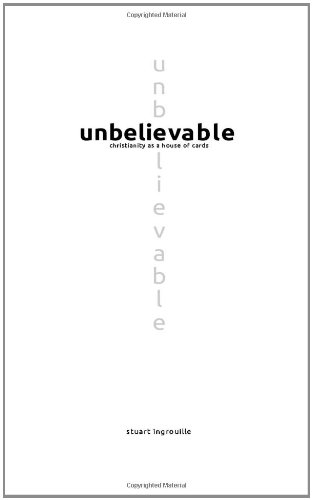
Well, my typescript is all formatted up, front and back covers and all (front cover pictured here). I've created a copyright page, including my permission from Cambridge University Press allowing me to quote form the King James Bible. I've got myself a barcode and ISBN and I've included a dedication and "by the same author" page, which mentions an unforgivably dismal little book (Scriblets) that I put together a few years ago, which is still available on Lulu and is yet to have made a single sale.
I must say that getting this blasted thing formatted has been a real headache. Not on the part of Lulu I hasten to add. It's just that I am not very good with Word documents or PDF's and such. It has been a real learning curve for me, sorting out things like page numbering on certain pages and not on others; different headers and footers for odd an even numbered pages and different headers for different chapters etc. - ugh!
Anyway, it's done now. I have submitted the damn thing to Lulu and am awaiting a proof copy to check for errors. Should be here in a day or two - fingers crossed, nearly there now.
Tuesday, 8 May 2012
Giving in to vanity
Well, I've finally done it. I've admitted defeat and done it. I first started 'researching' this project the best part of four years ago, and have been working on it on and off (mostly off) since then.
It is a book. A book called 'unbelievable: christianity as a house of cards'. And after several rejections from literary agents I have finally taken the hint.
Nonetheless, I should like to see it in print, for vanity's sake. Do I go with self publishing website lulu.com? Or do I go with a Kindle single? Well I'd like to do both in due course, but the old-fashioned curmudgeon in me yearns for the physical book, longs for the crisp printed page, and the new-fangled digital e-book can take a powder. For now anyway.
I shall post an overview of the book in due course, but right now I am busy trying to format the pesky thing; page numbering, title pages, headers and footers, table of contents, and other bebuggered things of that nature. I've also got to fabricate some kind of cover, obtain a barcode and ISBN, and find the right place to put my copyright permission for quoting the bible.
Wish me luck...
It is a book. A book called 'unbelievable: christianity as a house of cards'. And after several rejections from literary agents I have finally taken the hint.
Nonetheless, I should like to see it in print, for vanity's sake. Do I go with self publishing website lulu.com? Or do I go with a Kindle single? Well I'd like to do both in due course, but the old-fashioned curmudgeon in me yearns for the physical book, longs for the crisp printed page, and the new-fangled digital e-book can take a powder. For now anyway.
I shall post an overview of the book in due course, but right now I am busy trying to format the pesky thing; page numbering, title pages, headers and footers, table of contents, and other bebuggered things of that nature. I've also got to fabricate some kind of cover, obtain a barcode and ISBN, and find the right place to put my copyright permission for quoting the bible.
Wish me luck...
Subscribe to:
Posts (Atom)
ABOUT THE BOOK...
BUY THE BOOK...
...in print...
LuluAmazon.co.uk
Amazon.com
Waterstones.com
...or as an eBook
LuluiBookstore
NOOK Book
Kindle (UK)
Kindle (US)
REVIEWS
Appetizers
#1: On god and science#2: Apartheid in Eden
#3: Sacrifice
#4: The end is nigh
#5: Intellectual Dishonesty
Follow me on Twitter